

Mould is quite possibly the most frequent hazards your bathroom faces on the day-to-day basis. As most people know very well, mould spores are formed as a result of high levels of humidity and considering how damp and heated bathrooms usually get it is very easy for the air inside to get condensed and produce large amounts of moisture. That moisture will stick to walls and the ceiling and steadily develop into mould spores, slowly taking hold and eating away your house.
A few helpful tips that you can follow to protect your bathroom from the danger of mould are:
Ventilate your bathroom properly
The main reason why mould takes hold in bathrooms is the lack of proper ventilation. If your bathroom has a window, keep it open as long as possible to let the airflow inside. Otherwise, run the exhaust fan your bathroom might possibly be equipped with or invest into a dehumidifier to automatically manage the humidity level inside the room for you.
Exhaust fans and dehumidifiers will prove very useful even in case you have a window to work with.
Paint with anti-mould products
Unbeknown to most people is the fact that anti-mould products exist and just how useful they are in preventing the decline of your bathroom walls and ceiling. Anti-mould paint, for example, works in such a way that it creates a surface with condensation repelling abilities. If you choose to go down this road, though, you should know that the paint is not actually waterproof and it won’t offer any meaningful protection against water if the ceiling and wall are constantly exposed to excessive water.
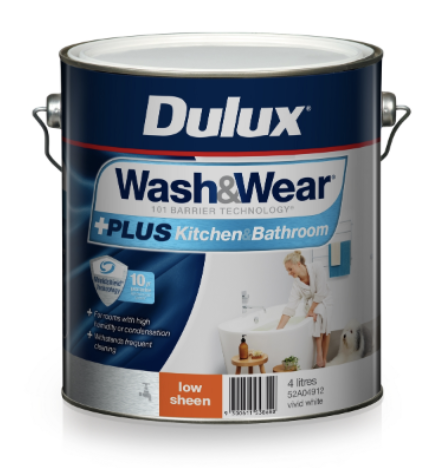
Dulux Wash & Wear +PLUS Kitchen & BathroomLow Sheen is an appropriate paint that can be used which is fortified with a powerful mould-inhibitor. This gives exceptional washability and is developed specifically for damp and humid environments such as bathrooms and laundries.
Cleaning walls and ceiling on your own
In the case that mould has already begun to show its signs, further actions to prevent its growth are impossible before eradicating the one accumulated. Your bathroom walls and ceiling will first have to be cleaned off for the previously mentioned tips to be effective.
Luckily enough, there are also a few tips you can follow for removing the accumulated mould.
Someone once said, “You are only as good as the tools you use” and as most people know very well, every job requires its own set of tools. If you choose to go the route of getting down and dirty yourself instead of calling for professional aid you should first equip yourself properly. Fortunately, cleaning off meagre amounts of mould doesn’t require more than a few essentials.
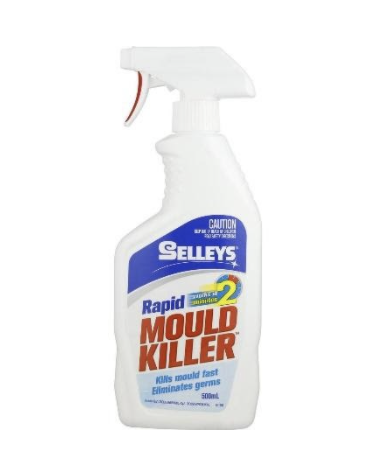
For the cleaning process we suggest to use Selleys® Rapid Mould Killer on the ceiling and walls. Leave the solution on the surface for 5 minutes then wash with clean water and wipe dry. Several applications may be necessary to remove stubborn mould blooms.
For your own safety, you will need to protect your hands and face so items like gloves, goggles and face masks are paramount if you don’t want to risk any health issue. If protective equipment is not used, severe burns may be produced as skin and eyes will be attacked. Vapours may be harmful and ensure adequate ventilation. This product is not recommended for people with respiratory problems.
Removing mould off tiles
We recommend using diluted vinegar which causes mould to overeat and die rather than a bleach-based product that may damage the surface of the tiles.
How to use vinegar to clean mould
- Pour a concentration of 80% vinegar to 20% water into three buckets.
- Grab a microfibre cloth, dip it into the first bucket, then use it for cleaning a patch of mould.
- The same microfibre cloth should then be rinsed in the second bucket, then rinsed again in the third to ensure cross-contamination doesn’t occur.
- Microfibre cloths, which reach deep into tiny crevices and have a slight electric charge, can be bought cheaply and washed on a hot cycle in the washing machine with vinegar up to 100 times.
- On completion, wash the tiles with soapy water
Mould in bathroom grout or silicone
These areas deserve a separate mention. Once mould gets its grip here, getting rid of it is almost impossible. When mould grows, it develops hyphae, or roots, which grow into the grout or silicone. You can clean the surfaces of the grout or silicone, but not deep into it. In those cases, you have to replace the silicone or re-grout your bathroom.
